Download AI, Machine Learning & Python for Chemical Engineers 2026
AI, Machine Learning & Python for Chemical Engineers, AI and machine learning for process engineers, built in Python on real distillation and reactor examples video course download. This course explores the practical application of artificial intelligence and machine learning in chemical engineering, providing a strong conceptual foundation alongside hands-on implementation using Python. Rather than focusing on memorizing algorithms, the course emphasizes understanding how machine learning models operate and why they are suitable for solving engineering problems.
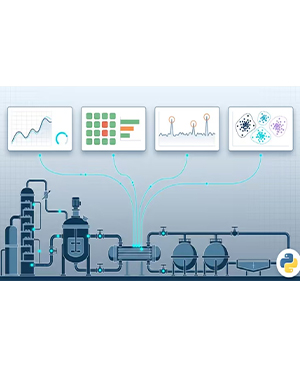
The learning experience is built around familiar chemical engineering processes, making complex AI concepts easier to understand. Topics are explained using real industrial examples such as distillation systems, chemical reactors, pipelines, wastewater treatment units, crude oil blending, and near-infrared (NIR) spectroscopy. By connecting theory with practical engineering scenarios, you’ll develop the ability to interpret, evaluate, and apply machine learning techniques with confidence.
Throughout the course, you’ll work with realistic process datasets to develop predictive models for industrial applications. Practical exercises include estimating product purity in distillation columns, predicting reactor performance, identifying abnormal operating conditions, detecting equipment faults, forecasting product quality from NIR spectral data, optimizing crude oil blending strategies, and deploying trained models to generate predictions from incoming process data.
A wide range of machine learning techniques is covered, including regression, classification, decision trees, random forests, gradient boosting methods such as XGBoost, clustering, and Principal Component Analysis (PCA). Each algorithm is introduced by explaining the underlying principles, appropriate use cases, strengths, and limitations before moving into implementation with Python.
This course is intended for chemical engineers, process engineers, engineering students, researchers, and professionals working in manufacturing, production, or R&D who want to integrate data-driven methods into their workflows. The Python notebooks are designed with clear, readable code, making the material accessible even to learners with only basic programming experience.
By the end of the course, you’ll be able to analyze industrial process data, select appropriate machine learning techniques, train and validate predictive models, evaluate their performance, and deploy them for real-world engineering applications. More importantly, you’ll gain a solid understanding of the concepts behind each method, allowing you to confidently apply machine learning beyond the examples presented in the course.
What you’ll learn
- Apply machine learning techniques to solve chemical engineering problems such as process modelling, parameter estimation, and fault detection.
- Build and deploy Python-based AI models for applications like predictive analytics, optimization, and control in chemical processes.
- Understand key AI concepts (supervised learning, unsupervised learning, neural networks, etc.) and how they relate to chemical process data.
- Integrate chemical engineering domain knowledge with data science workflows, including data preprocessing, visualization, model evaluation
Who this course is for
- Chemical engineering students who want to future-proof their careers by learning in-demand AI and Python skills
- Process and design engineers looking to apply machine learning to simulation, modeling, optimization, or plant data
- Academic researchers and graduate students aiming to enhance their experimental or simulation work using data-driven approach
- Data science or software enthusiasts with a background in chemical engineering who want to transition into AI-powered process industries
Course content
- Introduction
- Data Preprocessing & Feature Engineering
- Introduction to Machine Learning
- Supervised Learning: Linear Regression
- Regularization
- Cross-Validation & Hyperparameter Tuning
- Ensemble Methods for Regression
- Binary Classification
- Classification Metrics
- Multi-Class Classification
Course details
- Video quality: MP4 | Video: h264, 1280 × 720
- Audio quality: Audio: AAC, 44.1 KHz, 2 Ch
- Last updated 07/2026
- Video duration: 19h 15m
- Number of lessons: 14 sections, 98 lectures
- Language: Language: English
- Compressed file size: 9.3 GB