
Download AI in Drug Discovery – AlphaFold3 & Virtual Screening 2025
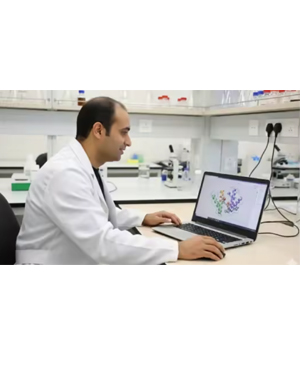
AI in Drug Discovery – AlphaFold3 & Virtual Screening video course download, Master AlphaFold 3 and Virtual Screening to Accelerate the Drug Discovery Using AI from Targets to Leads. Unlock the Future of Drugs Discovery with AI: A Comprehensive to Molecular Design and Scalable AI. This course provides a complete, end-to-end blueprint for using Artificial Intelligence to revolutionize how we find, design, and produce life-saving medicines.
We begin by diving into the AlphaFold Revolution. You will learn how to leverage AlphaFold 3 to solve the protein-folding problem, predicting complex 3D structures and protein-protein interactions with unprecedented accuracy. From there, you will master Structure-Based Drug Design (SBDD), moving beyond simple docking to AI-enhanced scoring functions that predict binding affinity more reliably than ever before.
What sets this course apart is its holistic approach. We don’t stop at discovery; we bridge the gap between the lab and the factory. You will explore:
- Generative AI: Using VAEs and GANs to “invent” novel molecules with optimized properties.
- Predictive ADMET: Reducing clinical failure by predicting toxicity and metabolism in silico.
- Case Studies: Real-world breakdowns of AI-designed drugs like Halicin and Rentosertib.
- AI in Manufacturing: Utilizing Machine Learning for Quality by Design (QbD) and optimizing the chemical synthesis of the Active Pharmaceutical Ingredient (API).
What you’ll learn
- The Career Pivoter – Joining the AI Drug Discovery
- Academic Researchers
- Digital Transformation Leads
- Future Bio-Entrepreneurs
Course content
- Introduction to the Course
- Al in Drug Discovery
- Introduction to Chapterl – Al in Drug Discovery
- The Drug Discovery Crisis
- Al Role in Drug Discovery
- Al Data Infrastructure for The Pharmaceutical Industry
- Al Data Infrastructure for The Pharmaceutical Industry – Part 2
- Practical Demo – The Drug Bank Database
- Practical Demo – The Proteins Database
- 1.4. Machine Learning in Chemistry
- 1.4. Practical Example – Machine Learning in Chemistry
- Introduction to Alpha Fold
- Chapter Content
- Introduction to Proteins
- 2.1. introduction to Amino Acids
- 2.1. Introduction to Proteins Structure
- 2.1. Introduction to Proteins Structure Details
- 2.2 Proteins Structure
- 2.2. Proteins Structures Database
- 2.2. The Protein Folding Problem
- 2.3. What is Alpha Fold 2/3
- 2.3. Practical Demo – What is Alpha Fold
- 2.4. Alpha Fold Testing & Validation
- 2.4. Alpha Fold Use Cases
- 2.5. How Alpha Fold Work
- 2.51. Alpha Fold Confidence Metrics
- 2.52. Confidence Scores for AlphaFold Multimier
- 2.5. Practical Demo – Alpha Fold Confidence Metrics
- 2.6. Accessing Alpha Fold
- 2.7. Advanced Modelling Applications Using Alpha Fold 3
- 2.8. Introduction to Alpha Fold 3
- Introduction to Structure Based Drug Design
- 3.1 Introduction to the Chapter
- 3.1. Fundamental Molecular Docking Principles
- 3.1. Installing AutoDock Vina and MGL tools
- 3.1. Introduction to Molecular Docking
- Introduction to Molecular Docking Modes
- 3.2. Introduction to Scoring Functions
- 3.21 Types of Scoring Functions
- 2.23 Limitations of Scoring Functions
- 2.24 Machine Learning for Scoring Functions
- 2.25. Scoring Functions Strategies
- Practical Demo – Proteins – Single Ligand Interactions Part 1
- Practical Demo – Proteins – Single Ligand Interactions Part 2
- 2.3. Introduction to High Output Virtual Screening
- 2.4. Al Assisted Virtual Docking
- 3.42. Al Assisted Virtual Docking 2
- 3.5. Case Study – Virtual Screening for Alpha Fold Targets
- Bioinformaticians & Computational Chemists: Professionals looking to upgrade their toolkit with Generative AI, AlphaFold 3 workflows, and automated retrosynthesis.
- Pharmaceutical Scientists & Pharmacologists: Traditional “wet-lab” researchers who want to understand the “dry-lab” AI revolution to better collaborate with computational teams or transition into In Silico roles.
- Data Scientists & AI Engineers: Tech professionals looking to pivot into the high-impact field of HealthTech and Drug Discovery by learning how to apply Deep Learning to biological data.
- Graduate Students (Masters/PhD): Students in Pharmacy, Biotech, or Computer Science seeking a practical, industry-aligned supplement to their academic studies.
- Biotech Entrepreneurs & Product Managers: Non-technical leaders who need to understand the realistic capabilities (and limitations) of AI to lead drug discovery startups or innovation teams.
- Process Engineers & Manufacturing Specialists: Those interested in the final “API” stage—how AI optimizes chemical synthesis, formulation, and Quality by Design (QbD) in a factory setting.
Course details
- Video quality: MP4 | Video: h264, 1280 × 720
- Audio quality: Audio: AAC, 44.1 KHz, 2 Ch
- Last updated 11/2025
- Video duration: 5h 8m
- Number of lessons: 13 sections, 128 lectures
- Language: Language: English
- Compressed file size: 4.73 GB