Download Computational Sciences by Ramasami
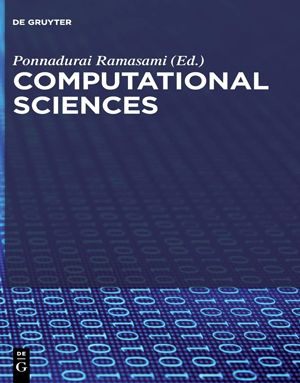
Computational Sciences by Ponnadurai Ramasami book pdf download, eleven carefully selected, peer-reviewed contributions from the virtual vonference on computational chemistry Science. Marcano investigated anthocyanidin and anthocyanin pigments for dye sensitized solar cells based on Density Functional Theory (DFT) method. DFT method was also used by Ranjan et al. to study silver-gold nanoclusters. Gbayo et al. applied DFT method to understand the mechanism of nucleophilic substitution reactions of 4-(4’-nitro)phenylnitrobenzofurazan ether with aniline in acetonitrile. Khairat et al. used high level ab initio method to probe the electronic states of two newly detected dications namely MgS and SiN. Palafox applied several ab initio methods to vibrational spectroscopy for a better characterization and assignment of all the bands of the experimental spectra.
Majee and Biswas used computational algorithm methods where Spatial Aggregation Propensity was employed and molecular dynamics simulation approach for prediction of aggregation prone areas in mono-clonal antibodies. Chowdhury et al. studied the optical and magnetic properties of free standing two-dimensional (2D) materials silicene, germanene and T-graphene while the contribution by Schwingenschlogl et al. provides a review of elemental two-dimensional materials beyond graphene. Ocaya and Terblans addressed the challenges of standalone multi-core simulations in molecular dynamics. Patade and Bhalekar analyzed pantograph equation with incommensurate delay and provide analytical solution. Chooramun et al. used the Hybrid Space Discretisation to simulate evacuation and this was applied to large underground rail tunnel station.
eBook details
- Author (s): Ponnadurai Ramasami
- Publication year: 2017
- Publisher: De Gruyter
- Language: English
- ISBN: 3110465361, 9783110465365, 9783110467215, 9783110465488
- Pages: 250
- Book format: PDF
- File size: 7 MB