Download Graph Neural Networks for Molecular Discovery with Python 2026
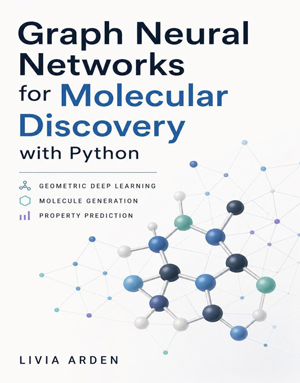
Graph Neural Networks for Molecular Discovery with Python: Geometric Deep Learning, Molecule Generation, and Property Prediction book pdf download. Graph Neural Networks for Molecular Discovery with Python by Livia Arden provides a practical introduction to the use of geometric deep learning for modern molecular research.
The book explores how Graph Neural Networks (GNNs) can transform molecular structures into meaningful graph representations and use them to support the discovery, analysis, and optimization of chemical compounds. With applications ranging from drug discovery and materials science to chemical engineering, it offers a bridge between machine learning concepts and real-world molecular problems.
Key Topics Covered
- Understand the core principles of Graph Neural Networks (GNNs) and learn how graphs can effectively describe atoms, chemical bonds, and molecular structures.
- Develop machine learning models capable of predicting important molecular properties, including solubility, toxicity, biological activity, and quantum-related characteristics.
- Discover modern approaches to molecular generation, covering graph-based variational autoencoders, generative adversarial networks, and diffusion-based models.
- Build practical molecular machine learning pipelines with popular Python libraries, including PyTorch Geometric, DGL, RDKit, and NetworkX.
- Learn how to handle essential challenges such as molecular feature representation, graph pooling, attention mechanisms, and efficient training with large-scale chemical datasets.
- Explore advanced methods such as equivariant neural networks, 3D molecular modeling, and multi-task learning, with applications in virtual screening and computational discovery.
Practical Learning Through Python
The book places a strong emphasis on implementation, providing clear and reusable Python examples throughout the learning process. Readers can follow complete workflows that begin with molecular representations such as SMILES and progress toward constructing molecular graphs, preparing datasets, training predictive models, and evaluating or generating new chemical structures.
By combining theoretical explanations with practical programming exercises, the book demonstrates how GNN-based approaches can be incorporated into reproducible research and real-world molecular discovery workflows. The examples are designed to help readers adapt the techniques to their own research projects, computational experiments, and machine learning applications.
Graph Neural Networks for Molecular Discovery with Python is designed for data scientists, machine learning engineers, computational chemists, and researchers who want to explore graph-based artificial intelligence in scientific applications. It is also relevant to graduate students and professionals working in cheminformatics, bioinformatics, materials informatics, and computational molecular science.
The book is particularly useful for readers interested in combining geometric deep learning with chemistry and molecular modeling. Whether the objective is to predict molecular properties, identify promising compounds through virtual screening, or generate new molecular candidates, the techniques presented in this book provide a practical foundation for developing modern AI-driven discovery workflows.
With its combination of Graph Neural Networks, Python programming, geometric deep learning, and molecular modeling, this book is a useful resource for anyone seeking to move beyond conventional cheminformatics and explore data-driven approaches to molecular discovery.
- Author (s): Livia Arden, Alice Schwartz
- Year of publication: 2026
- Publisher: Independently published
- Language: English
- ISBN: B0H6KR68XY, 979-8184214115, B0H6M9LXL3
- Number of pages: 449 pages
- Book format: PDF
- File size: 2 MB