
QuantumATK Synopsys Y-2026.03 Linux Download

QuantumATK 2026 Linux Version download from Synopsys QuantumATK with crack and licence for Linux. QuantumATK and quantumwise vnl download is a part of quantumwise virtual nanolab (VNL). QuantumWise develops commercial software for fast and reliable atomic-scale modeling of nanostructures, fully supported and delivered in an easy-to-use interface, tailored from state-of-the-art methods, and developed by experts to the specifications of our customers.
Highlights of the QuantumATK S-2021.06 Release Notes
- Machine-Learned (ML) Force Fields | Moment Tensor Potentials (MTPs)
- Complex Semiconductor Materials, Interfaces and Gate Stacks
- 1D and 2D-Material Based FETs
- Novel STT-MRAM Memory Design
- Advanced Surface Process Simulations
- Battery Materials Modeling and Design
- Polymer Modeling
Synopsys QuantumATK X-2025.06 Release Notes
- On average 10x+ speed-up of the most time-consuming parts of bulk and NEGF device calculations, including SCF, bandstructure, PDOS, PLDOS, and transmission spectrum.
- Support for multi-node and multi-GPU with linear acceleration with the number of GPUs.
- Shifting the run-time for 5,000 atoms with DFT or 30,000 atoms with Semi-Empirical NEGF from days to just a few hours.
- ~2x speed-up for all SCF & geometry optimization with MetaGGA, GGA, and Hubbard U for small/medium system sizes (a few hundred atoms).
- Up to ~5x faster PDOS, FatBandstructure and MAE analysis, with speed-up increasing with the number of projections.
- Framework for training new and fine-tuning universal MACE models for a specific system/process with improved accuracy.
- Interface for import, rapid testing and usage of emerging MLP models, based on DeepMD, ORB, SevenNet, MACE, CHGNet, etc.
- Multi-GPU acceleration of MLPs enables large scale MD simulations, e.g. 100,000 atoms with MACE and 1,000,000 atoms with MTPs.
- New methods for simulating room-temperature diffusion and extracting diffusion coefficients:
- Accelerated Collective Variable Hyperdynamics (CVHD) gives up to 300x speed-up over standard MD to capture rare events.
- Adaptive Kinetic Monte Carlo (AKMC) with new Lanczos and ARTn saddle search methods iteratively probes new states, possible transitions, and energy barriers between them.
- Support for complex substrate shapes, such as U-shaped and 2D materials, in deposition/etching processes.
- MD simulations with variable time-step for accurate modeling of impact surface processes without having to use a small time-step for the entire simulation.
- New sequential IDDP method for setting up complex reaction paths in NEB.
- New techniques to improve and speed-up NEB reaction path optimization.
- 2-3x faster refinement of transition state search and reaction barrier calculations when combining NEB with new Dimer and Lanczos methods for saddle point search.
What’s New in QuantumATK Y-2026.03
QuantumATK Y-2026.03 introduces a range of improvements focused on performance, scalability, usability, and advanced atomistic modeling.
Key Improvements
- Advanced DFT: Improved DFT solvers, better convergence stability, and enhanced support for hybrid and meta-GGA functionals.
- Quantum Transport: Upgraded NEGF algorithms with improved stability and faster simulations for 2D materials, tunneling devices, and nanoscale transistors.
- HPC Performance: Improved parallel scaling across multi-core CPUs and clusters, enhanced GPU acceleration, and optimized memory usage for large simulations.
- Machine Learning: Emerging support for machine-learning interatomic potentials and data-driven simulation workflows.
- Multi-Scale Modeling: Integration of DFT, Semi-Empirical methods, and Molecular Dynamics within a unified simulation environment.
- NanoLab & Python API: Improved NanoLab usability, visualization, automation tools, and Python scripting capabilities.
- Simulation Tools: Enhanced geometry optimization, phonon and vibrational analysis, visualization, and workflow automation.
- Performance & Stability: Faster SCF convergence, reduced computational time, improved data handling, better restart capabilities, and enhanced MPI stability.
- Bug Fixes: Improved compatibility with recent Linux distributions and compilers, along with fixes for convergence issues, memory leaks, and NanoLab stability.
Overall, QuantumATK Y-2026.03 provides a more efficient and reliable environment for quantum mechanical, atomistic, and device-level simulations on Linux systems.
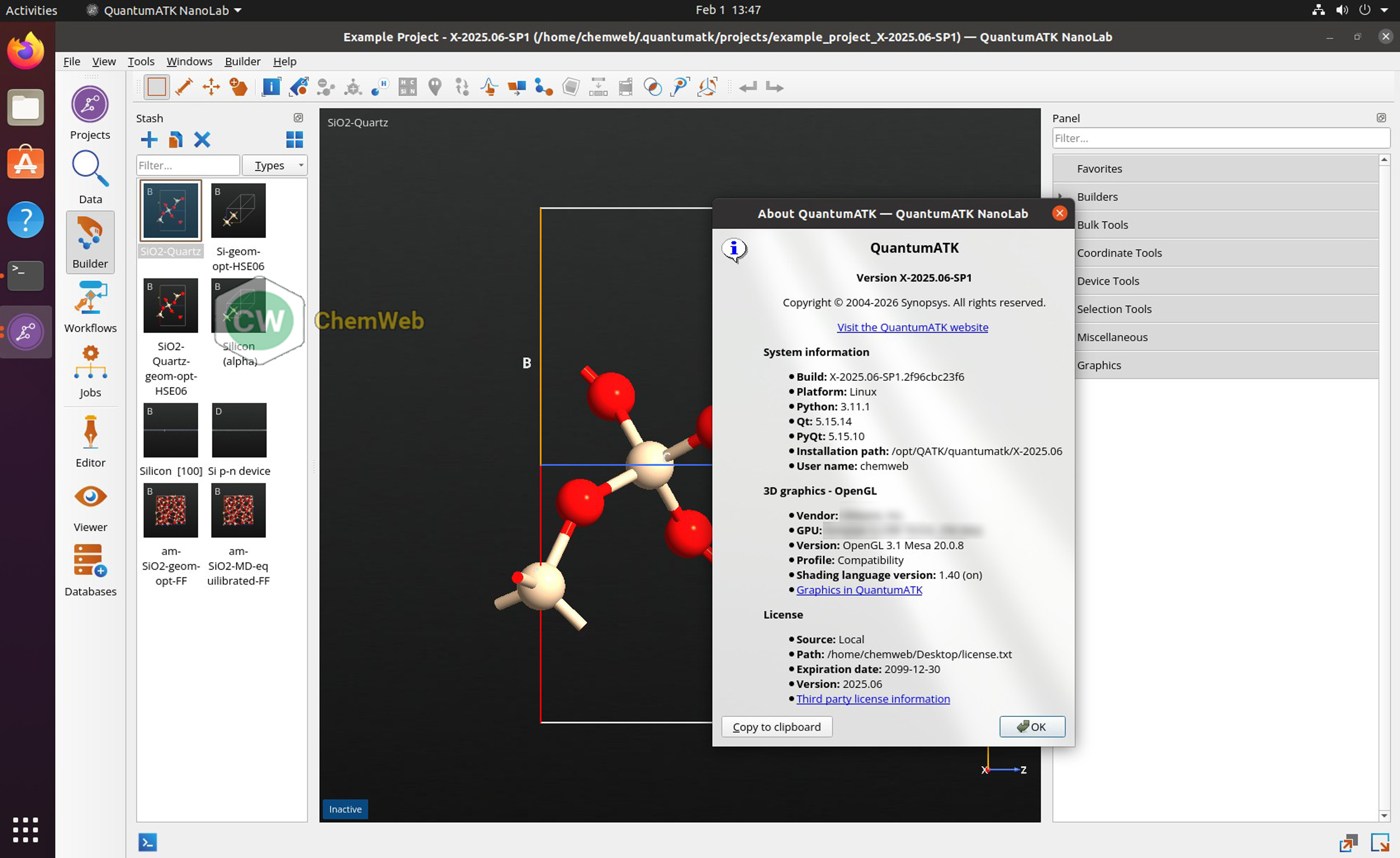
QuantumATK Synopsys X-2025.06 Linux
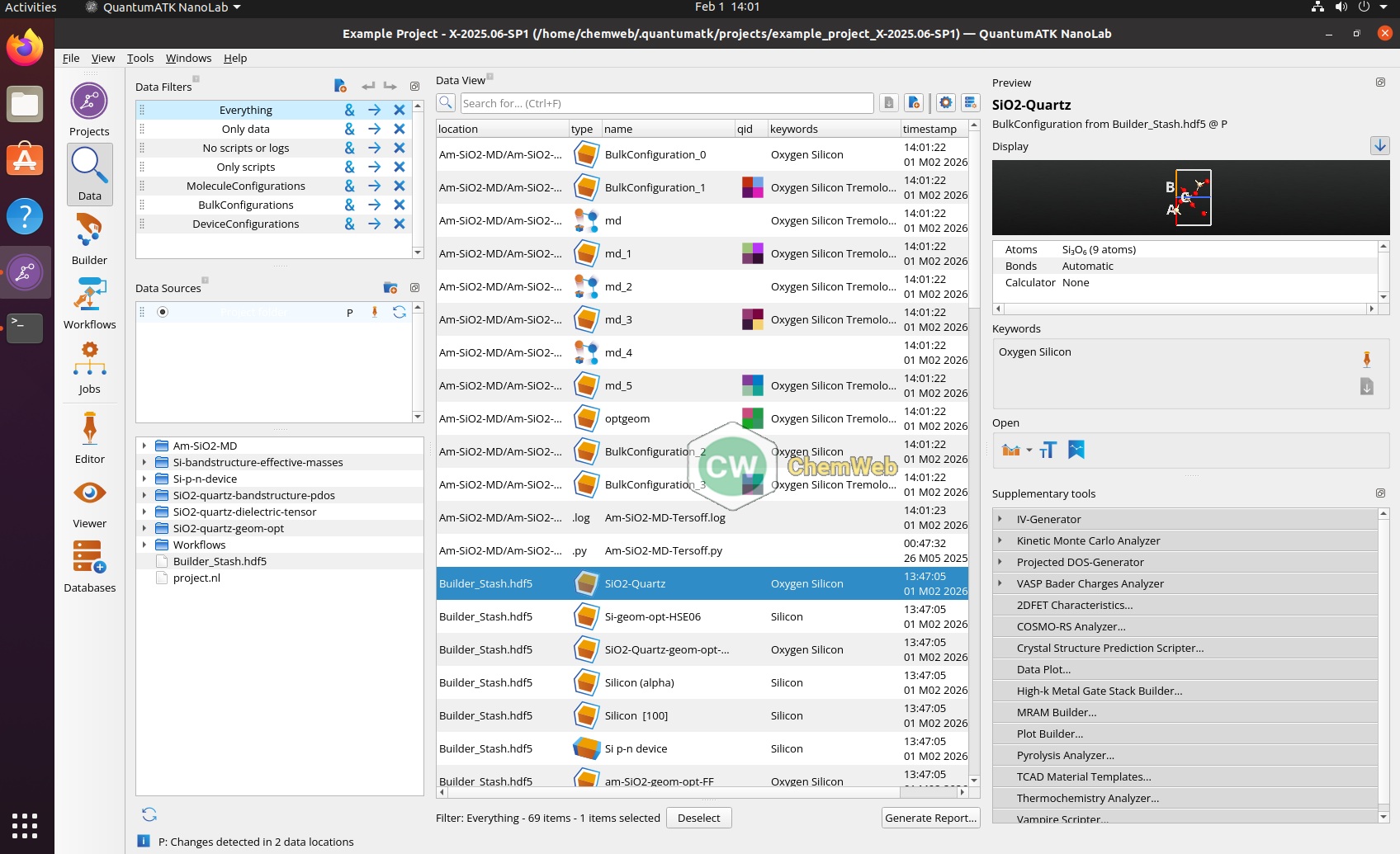
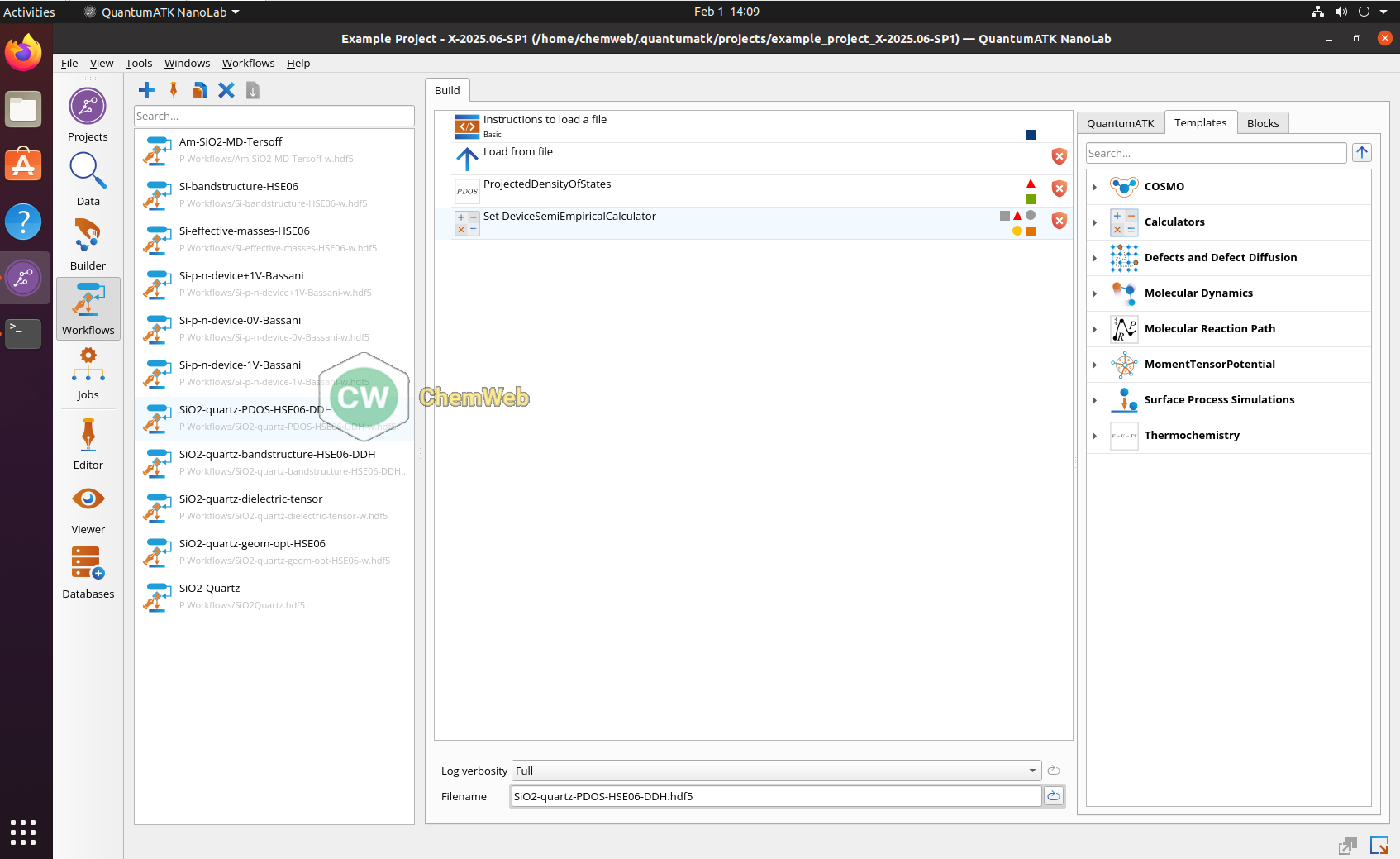
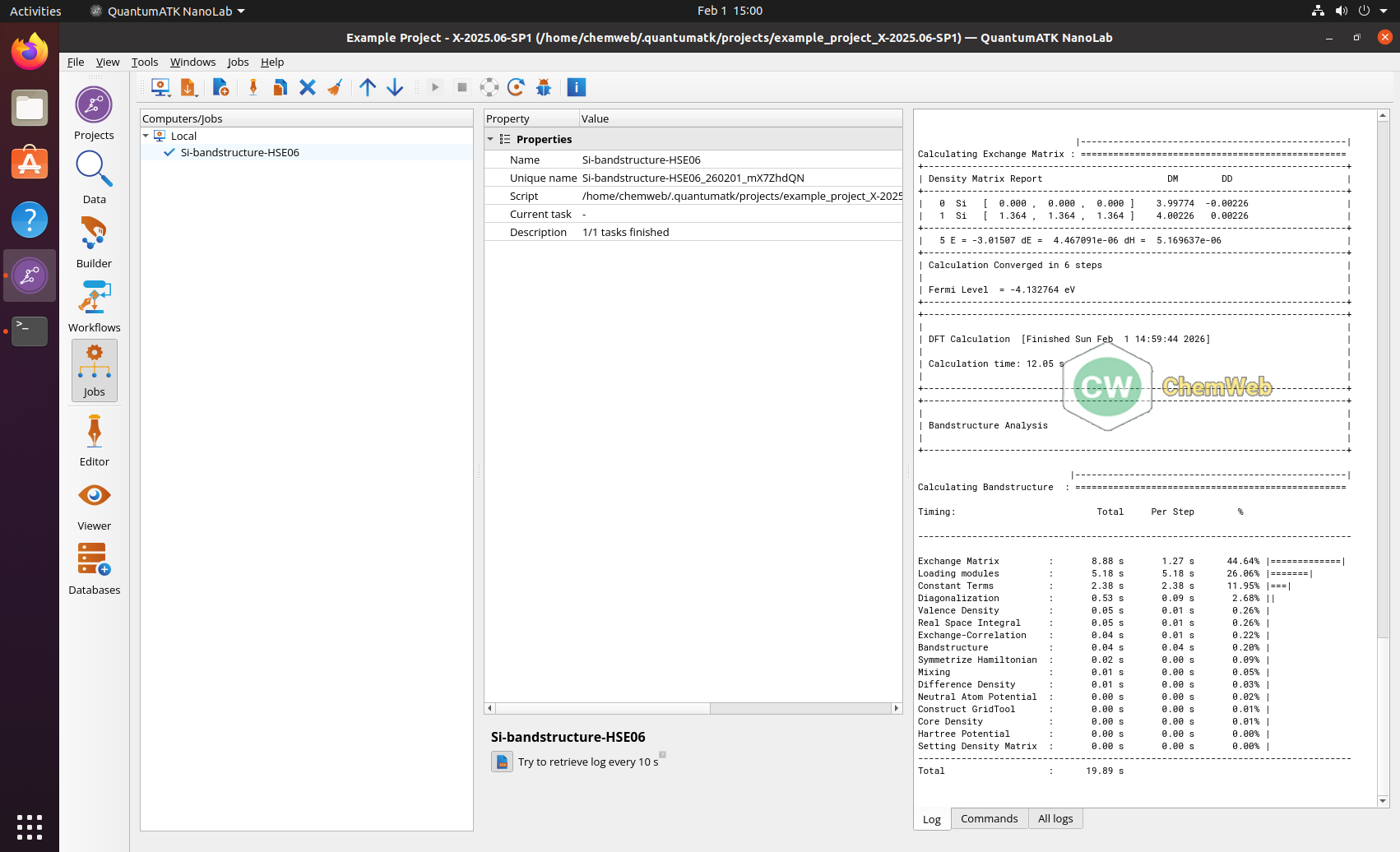
QuantumATK Synopsys X-2025.06 Linux
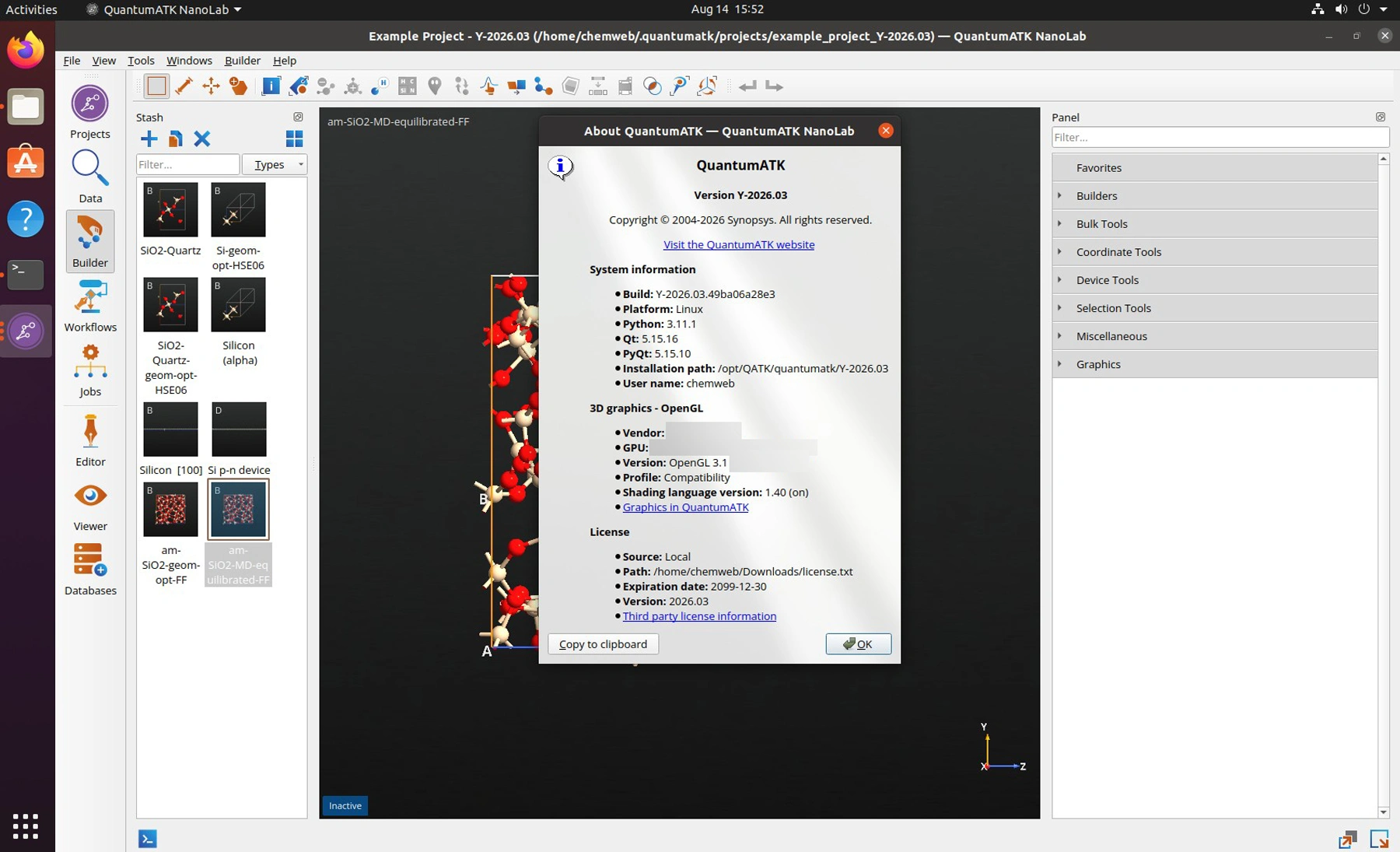
QuantumATK Synopsys Y-2026.03 Linux
Details of QuantumATK R-2020.09-SP1
- Version: 2020.09-SP1
- Revision: 51397f
- Operating System: Real Linux (not a virtual machine) or cluster
- Crack: Full Version
- Active: with licence
- Licence Type: Single User lifetime
- File Size: 1.03 GB
Details of QuantumATK S-2021.06
- Version: S-2021.06
- Revision: c144cd4
- Operating System: Real Linux (not a virtual machine) or cluster
- Crack: Full Version
- Active: with licence
- Licence Type: Single User lifetime
- File Size: 1.01 GB
Details of QuantumATK X-2025.06
- Version: X-2025.06
- Revision: 0a54f6b0d3b
- Operating System: Real Linux (not a virtual machine) or cluster
- Crack: Full Version
- Active: with licence
- Licence Type: Single User lifetime
- File Size: 4.1 GB
Details of QuantumATK Y-2026.03
- Version: Y-2026.03
- Revision: 49ba06a28e3
- Operating System: Real Linux (not a virtual machine) or cluster
- Crack: Full Version
- Active: with licence
- Licence Type: Single User lifetime
- File Size: 5.8 GB

Comments