
Download MedeA 3.12.2 + license

Download MedeA 3.12.2 software license crack package is the leading environment for the atomistic simulation of materials. MedeA enables professional, day-to-day deployment of atomic-scale and nano-scale computations for materials engineering, materials optimization and materials discovery. In MedeA, world-class simulation engines are integrated with elaborate property prediction modules, experimental databases, structure builders and analysis tools, all in one user-friendly environment.
The standard MedeA Environment includes the following modules:
- Builders: Solids, surfaces, point defects, random substitution, polymer, molecules, layers
- Databases: COD (Crystallography Open Database)
- Job Control: Jobserver/Taskserver (web-based job control and job monitoring)
- Compute engines: LAMMPS code
- GUIs: LAMMPS GUI, graphical workflow editor
- Analysis: Geometry, symmetry, void, point defects, trajectory, volumetric


Download MedeA software 3.9.0
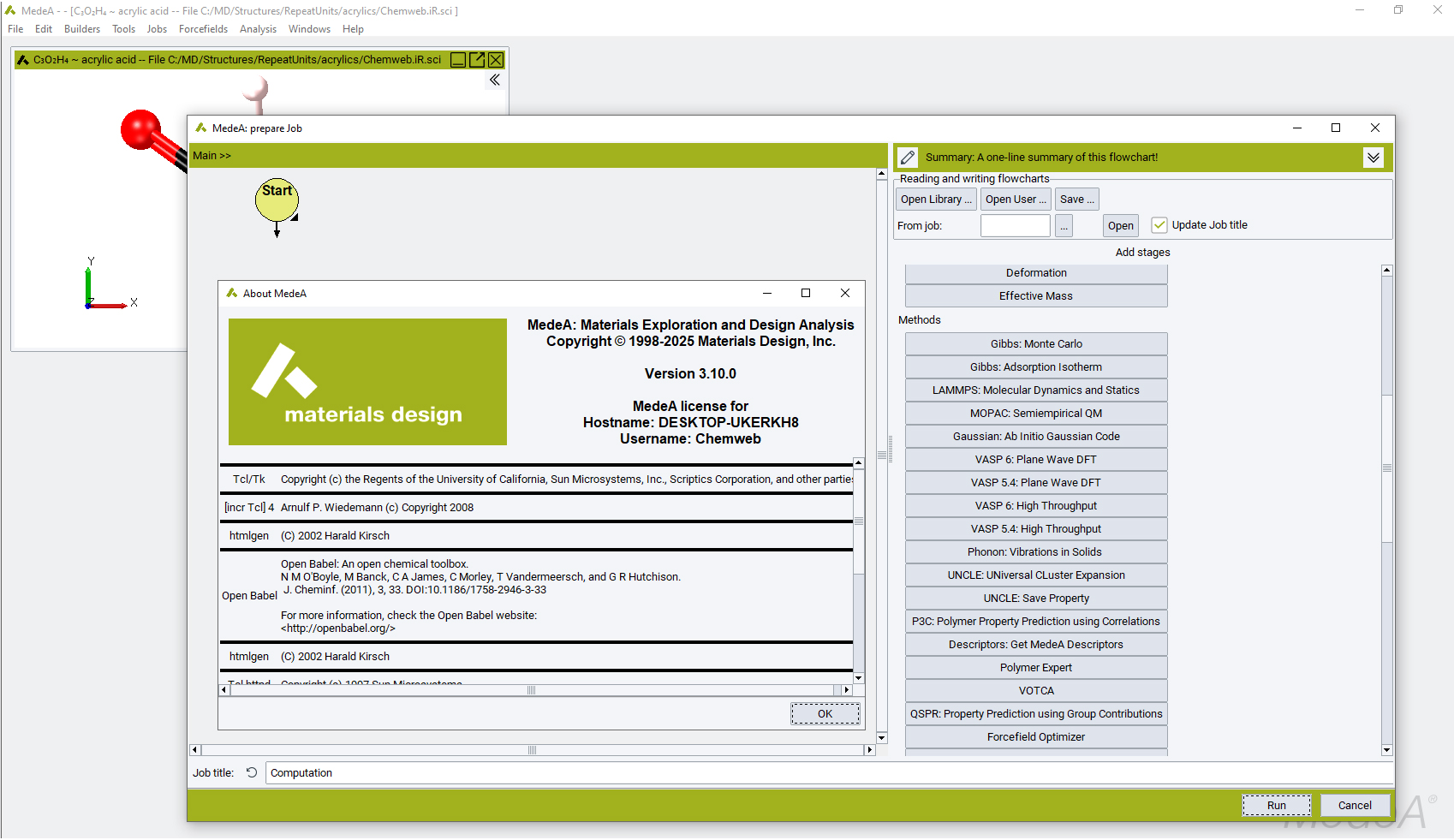
MedeA materials design 3.10.0
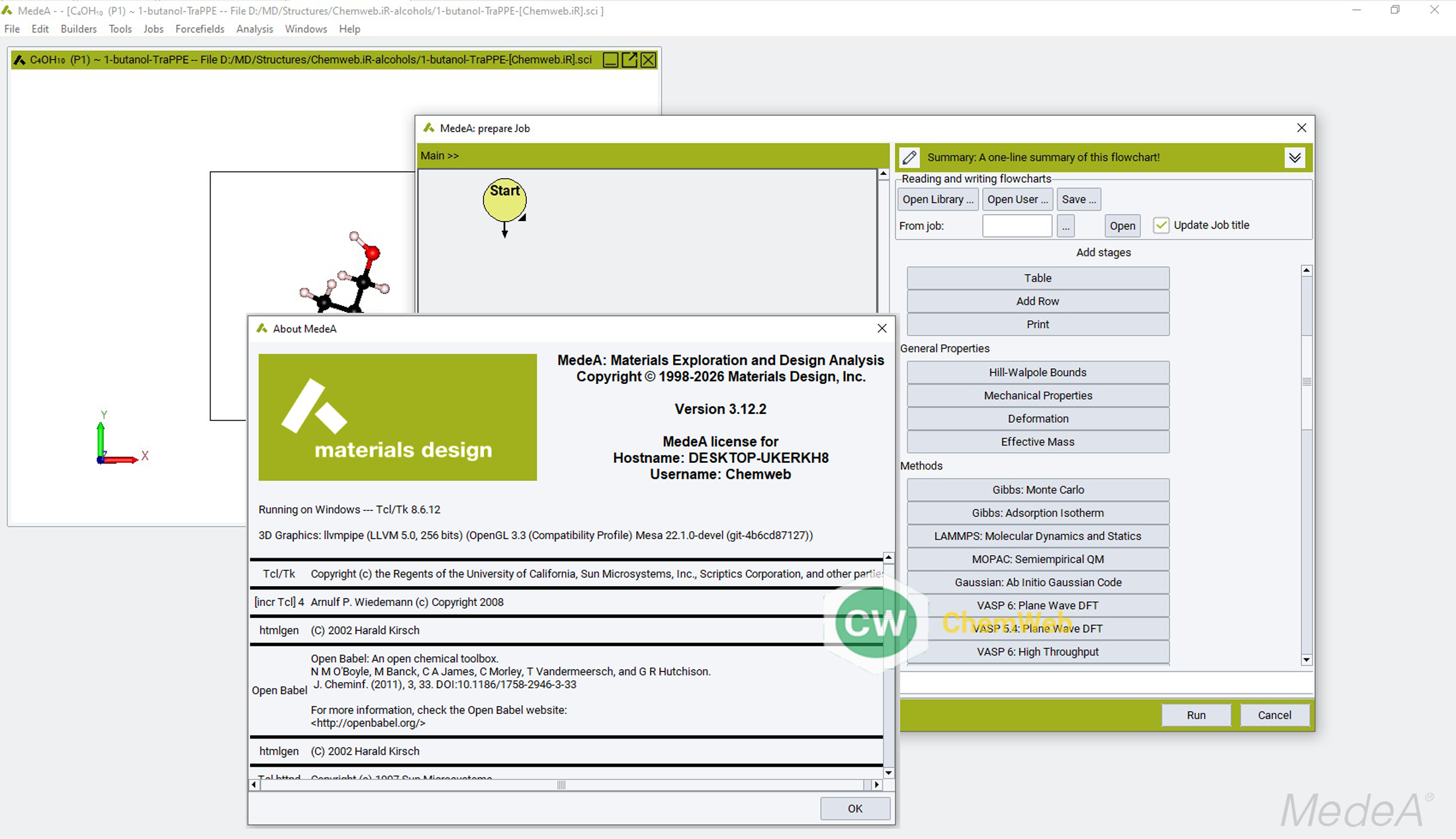
MedeA materials design 3.12.2
Compute Engines and related GUIs
MedeA VASP, MedeA VASP GUI – Vienna Ab Initio Simulation Package, Graphical User Interface
MedeA LAMMPS, MedeA LAMMPS GUI – Large-scale Atomic/Molecular Massively Parallel Simulator, Graphical User Interface
MedeA GIBBS, MedeA GIBBS GUI – Grand Canonical Monte Carlo method for fluid properties prediction and fluid adsorption, Graphical User Interface
MedeA MOPAC, MedeA MOPAC GUI – Semi-empirical Quantum Chemistry method for fast property prediction and screening, Graphical User Interface
MedeA Gaussian GUI – Flowchart based GUI for GAUSSIAN, a general purpose computational chemistry software package
MedeA offers several optional Property Modules for property prediction and automation
Property Modules working with VASP:
MedeA MT – Mechanical, thermal properties
MedeA Phonon – Vibrational properties and thermodynamic functions
MedeA Electronics – 3D electronic analysis, Seebeck coefficients, electronic conductivity, effective masses
MedeA Transition State Search – Reaction pathways and transition states
MedeA UNCLE – UNiversal CLuster Expansion for alloying, defects, configurational disorder
MedeA FFO – Forcefield Optimizer and include B3LYP hybrid
Property Modules working with LAMMPS:
MedeA Phonon – Vibrational properties and thermodynamic functions
MedeA MT – Mechanical, thermal properties
MedeA UNCLE – UNiversal CLuster Expansion for alloying, defects, configurational disorder
MedeA Diffusion – Automated calculation of diffusion coefficients
MedeA Thermal Conductivity – Automated calculation of thermal conductivity coefficient
MedeA Viscosity – Automated calculation of viscosity
MedeA Surface Tension – Automated calculation of surface tension
MedeA Cohesive Energy Density (CED) – Automated calculation of cohesive energy density
MedeA FFO – Forcefield Optimizer
MedeA Deposition – Automated deposition of atoms/particles on materials surfaces
Property Modules base on Correlations:
MedeA P3C – Polymer properties from Correlations, employing the Bicerano method
MedeA QT – An interactive Toolkit for statistical correlations
Builders:
MedeA Amorphous Materials Builder – Amorphous structures, Polymers, Thermosets
MedeA Docking – Adsorbate systems
MedeA Interface Builder – Heterogeneous crystalline interfaces and grain boundaries) are available as add-ons.
MedeA Morphology – Crystal morphologies
Databases
MedeA COD GUI – Crystallography Open Database
MedeA ICSD – Inorganic Crystal Structure Database
MedeA Pearsons – The Pearsons database
MedeA Pauling – The Pauling database
MedeA NCD – The NIST Crystal Database
MPDS – Materials Platform for Data Science (web-based)
Materials Design
msipd
NCD_Inorganic
NCD_Organic
MedeA 3.8.0 Release Notes
- Microstructure Builder (New)
- The MedeA Microstructure Builder creates microstructure models for atomistic simulations using a Seed & Growth algorithm with starting points either placed randomly or at user-specified coordinates within a supercell. Each such point is used as an origin to grow a crystalline grain by adding atoms from that seed point outwards until a grain boundary is encountered.
- The models created by the MedeA Microstructure Builder can be used with other MedeA tools to explore the structural, energetic, and dynamic characteristics of microcrystalline materials.
- Enhancements for exporting structures to extxyz
- Enhancements for bond computation
- Enhancements for assigning element colors
- Addition of the ability to use a variable for density in the amorphous builder stage
- Added an automated orthorhombic construction mode to the Supercell Builder. This functionality is made available if the active structure is non-orthorhombic.
- VASP 6.4.2 executables for Linux and Windows
- Structure optimization: all combinations of constraints for atom positions, cell volume and shape are available
- Added support for several Molecular Dynamics features through the user interface:
- The microcanonical ensemble can be executed in two ways, one is consistent with older VASP versions
- Canonical ensemble (nVT) ensemble: users can now choose Nose-Hoover, Andersen, and Langevin thermostats and their parameters
- Added isoenthalpic isobaric (nPH) ensemble (New)
- Added lattice constraints and monitoring for the isothermal isobaric (nPT) and isoenthalpic isobaric (nPH) ensembles. The options are:
- isotropic
- fixed lattice angles
- constrained
- unconstrained
- Short access time when loading machine-learned forcefields
- New calculation type to refit machine-learned forcefields:
- for fast running applications, or
- with Bayesian error prediction, or
- with reselected local reference configurations
- New user interface for fine-tuning the on-the-fly machine learning process and the refitting of forcefields. For instance:
- thresholds for Bayesian errors of forces and their updating process
- thresholds for configurations and sparsification
- relative fitting weights of energy, forces and stress
- atomic reference energies
- definition of descriptors and the basis set expansion
- output options
- Versatile trajectory creation, in particular for MLFF based molecular dynamics and on-the-fly learning
- Updated gnuplot graphics for machine learning
- Improvments for return status handling
- Enhancements for band structures based on non-local functionals without range separation
- Adapt low scaling GW to VASP 6.4.2 executables
- Update of automatically produced plots (post-processing)
- Addition of option for writing a trajectory in native LAMMPS format
- Addition of warning if there are frozen atoms during an NPT run
- Optimization of transition states accessible in flowcharts
- Enhancement to allow for manual assignment of structures to training/validation sets
- Addition of “Coordinates” property when importing into the Fitting Data Manager
- Enhancements on forcefields handing in FFO
- Refined nonbond parameters for carbon in acetal groups
4- Property modules:
- The Polymer Expert is a new module in the MedeA environment in MedeA 3.8. The innovative Polymer Expert capability facilitates de novo polymer design through high-efficiency access to a substantial (>1.1 million entries) database of polymer properties, PEARL (Polymer Expert Analog Repeat unit Library). Polymer Expert allows you to identify novel polymers by querying the PEARL database based on properties and property ranges. You can also search for biologically derivable analogs within the PEARL database. Polymer Expert was developed in collaboration with Jozef Bicerano the author of Prediction of Polymer Properties, Marcel Dekker, Inc. (2002) and is described in the paper (J. Bicerano, D. Rigby, C. Freeman, B. Leblanc, and J. Aubry, Polymer Expert – A Software Tool for De Novo Polymer Design, 2023 – which has been submitted for publication).
- In consultation with Jozef Bicerano, a variety of upgrades to P3C have been made in the MedeA 3.7.1, 3.7.2, and MedeA 3.8 releases. In particular:
- The naming of mechanical properties has been updated to clarify the temperature of the properties reported by P3C.
- Mechanical properties are generally reported at 298K. When a polymer has a computed glass transition temperature (Tg) below 298K, the Young’s modulus (Eyoung298K), shear modulus (Gshear298K), and the shear yield stress (Sy298K) are set to -1.0 so as to avoid providing misleading properties.
- The bulk modulus (B298K) is computed using correlations which account for low Tg (lower than 298K) materials and incorporates a transition region for materials with Tg’s close to 298K.
- The Poisson ratio, vpoisson298K, is computed for materials with Tg’s greater than 298K using a simple correlation, and for materials with Tg’s lower than 298K for the onset of the rubbery region for that polymer.
- Two new properties, EyoungTgp30K and GshearTgp30K, are now reported. These are the Young’s modulus and shear modulus at the onset of the rubbery region, i.e. 30K above the polymer’s Tg.
- Property descriptions have been updated to reflect the enhancements to mechanical property reporting described above.
- Properties are now reported with 2 decimal places, except for the Poisson ratio, which is reported with 4 decimal places.
- An additional Critical molecular weight property – using an alternative correlation described in Jozef Bicerano’s Prediction of Polymer Properties, Marcel Dekker, Inc. (2002) has been implemented.
- The thermal expansion, aT, has been updated to make this property a continuous, rather than discontinuous, function of Tg.
- A number of descriptor enhancements have been incorporated improving property prediction accuracy.
- Systems with more than 100 atoms may now be treated by P3C in the interactive P3C panel, upon user request.
- P3C no longer provides results for systems containing phosphorous and iodine, as repeat units containing these elements were not available during the original parameterization of P3C.
- Predictions for polymers with just silicon and nitrogen on the backbone, e.g. poly(dimethyl silazane), have been enhanced.
- Thermal conductivity, Tc, has been added to the properties computed by P3C
- The handling of the output of gas permeabilities has been enhanced.
- The treatment of rotatable bonds in siloxane alkyl side chains has been enhanced, based on input from Jozef Bicerano, to improve the predictive capabilities for such systems.
- In general, predicted Tg values below 100K represent extrapolation significantly below the bottom of the range of data used in developing the P3C equation. Accordingly, when P3C might compute a Tg<100K for a given repeat unit it now provides a report stating that this repeat unit is outside of the current applicability range of P3C.
- Similarly, elastic moduli are never negative in practice. If P3C calculates one or more negative moduli, because the input descriptors are outside of the ranges employed in the development of P3C’s correlations, it provides a message stating that the repeat unit is outside the current applicability range of P3C.
- Enhancement for interactive computation for large repeat units (on-demand)
- Enhancements for subsets used in deposition
- Short access time when loading machine-learned forcefield
- Output enhancements
- Enhancement for pair correlation panel
- Addition of the MedeA Python environment
- Update of IntelMPI to 2019 version on Linux
MedeA 3.9.0 Release Notes
1. Builders and Editors:
- Enhancements in exporting SVG files
- OpenBabel update
- Amorphous Materials Builder:
- Improved handling of removed components
- New compress layer functionality for quick and robust use, interactively and in a flowchart, for building layers at the desired density
- Updates to trajectories handling
- Extended Stack Layers builder to allow for stacking triclinic cells
- Ability to create repeat units from SMILES
- Enhancements for mass criterion when creating Subsets
- Microstructure builder:
- Weighted seed & growth to create grains of different volume distributions
- Option to create columnar slab geometries and rotations around z-axis only
- Flowchart stage for builder to be used in a flowchart
2. Engines:
VASP:
- Update to the latest release VASP 6.4.3 with many enhancements and bug fixes
- New OpenACC-based GPU version which now supports all features of the CPU version
- Added support for new VASP 64 potentials. Users can choose their own default and switch easily between 54 and 64 potentials
- Added support for the revPBE density functional from the user interface
- Added support for further Van der Waals density functionals from the user interface: vdW-DF-cx, rVV10, r2SCAN+rVV10, PBE+rVV10L
- Added support for further meta-GGA functionals from the user interface: SCAN-L, rSCAN-L, r2SCAN-L, v1-sregTM, v2-sregTM, v3-sregTM, v2-sregTM-L, OFR2, local MBJLDA
- Added support for further hybrid functionals from the user interface: HSE03, HSEsol, RSHXLDA, RSHXPBE, SCAN0
- Added support for the van der Waals corrections Many-body dispersion energy /FI and DFT-ulg from the user interface
- Davidson optimization algorithm (non-blocked) available for all simulations
- CSVR thermostat for canonical (nVT) ensemble
- Enhancements for MLFF Molecular Dynamics simulations and trajectory handling
- Substantial speed-up of post-processing of Molecular Dynamics runs
- NMR Calculation enhancements: vGv approximation for evaluating the magnetic susceptibility
LAMMPS:
- Enhancements in NPT, Minimize and Compress Layer stages to allow for the use of variables
GIBBS:
- Several enhancements for GIBBS trajectories and structure list
- visualization
- Enhancements for Sorption stage
3. Forcefields:
- MLPs:
- Added ZBL parameters to SNAP MLPs
MLPG:
- New MLP type supported: ACE (New)
- Fitting Data manager enhancements
- Enhancements to forces’ charts
- Ability to use variables for hyperparameters
VOTCA (New):
- New module for coarse-grained forcefield creation from atomistic simulation input (Iterative Boltzmann Inversion and Force Matching methods)
- Machine-Learned Atomic Cluster Expansion (ACE) Potentials based on the PACEMAKER code,
- Enhanced VASP Quantum Engine with new density functionals and Projector Augmented Wave (PAW) potentials, designed for performance on the latest graphics processors,
- Improved atomistic forcefields enhancing the accuracy of simulations and their applicability in diverse research areas, and
- Innovative VOTCA module for seamless parameterization of coarse-grained forcefields from atomistic simulations for mesoscale applications.
PCFF+:
- New atom types and parameters for alkyl borates
- Refinement for quaternary carbon c0 nonbond parameters
- New atom type for alumina and updated for surface atoms
- Addition of bond term and bond increment for alpha carbon in carbonates
- Enhancements for oxalatoborate anions and new atom types
ReaxFF:
- Added CHONS ReaxFF parameter set (Mattsson et al.)
- New torsion terms for use with UFF in LAMMPS
4. Property modules:
UNCLE:
- Improvements to message handling, initial and final structure reporting, and checks for the number of requested structures
- Enhancements for Optimization stage
P3C:
- Enhancements for computation of X3 and X10 descriptors, and perception of ortho/meta geometries
Phonon:
- Enhancements for computations using NNP (MLP) forcefields
MD Phonon:
- Added Etot_QC, sum of MD total energy and the quantum correction of the vibrational energy
- Added Atotal, the total vibrational Helmholtz free energy, which is calculated with Etot_QC – Svib T
- Enhanced support of Job restart functionality
Polymer Expert:
- Enhanced handling of messages and warnings issued
Deposition:
- Enhancement for use of variables to define regions
6. JobServer/TaskServer:
- Extended Job submission dialog to include summary regarding the JobServer chosen, the input structure and the active forcefield
- Extended Job submission dialog to include Queuing System options
- Extended TaskServer for GPU device selection
- Enhanced database performance
MedeA 3.10.0 Release Notes
An overview of updates in this MedeA release is provided below.
1. Builders and Editors:
Building and editing periodic structures:
- Create non-collinear magnetic structures with spin vectors assigned to atoms
- Switch between collinear (scalar) and non-collinear (spin vector) magnetic structures and vice versa in the Edit Atom tab of the Edit structure… menu
- Automatically initialize non-collinear magnetic moments upon switching to non-collinearity
- Edit non-collinear magnetic moments (spin vectors) in the Edit Atom tab of the Edit structure… menu or the Atoms spreadsheet
- Process non-collinear magnetic structures in MedeA’s Builders and Editors
- Handle non-collinear magnetic moments to initialize non-collinear and spin-orbit magnetic VASP calculations
Polymer builder:
- Enhancement for repeat units’ recognition
Thermosets:
- Enhancement for retrieving build cycle trajectories
Amorphous Materials builder:
- Added ability to use a custom forcefield and ship it to the Job Server to be used, even if no other stage is present in the flowchart
Flowchart:
- New “Append to list” stage
Subsets:
- Enhanced user interface for the creation and use of pair/triplet/quadruplet subsets
- Enhancements in the visualization of pair subsets
- Extension of operations in the Subset Manager (combine subsets)
- Enhancements for the use of variables to define subsets in “For” loops
- Extensions for the creation of supercells in Flowcharts
- Enhancement for ring catenation checks
- Enhancement for speed-up of duplicate checking when importing lists in the Fitting Data Manager
Random Substitution:
- Enhancement for use of isotopes
- Enhancements for sorting of columns in the Atoms spreadsheet
- Extended information provided when Forcefield Optimizer is used with a forcefield which contains “bond-increments” for the charge assignments
Microstructure Builder:
- Enhanced printing of information, help messages and warnings
- Added support for space group Pn as an alias for P1n1
2. Databases:
- Enhanced space group handling for ICSD
- New Polymer Expert databases
3. Compute Engines:
VASP:
- Initialize non-collinear magnetic moments from non-collinear magnetic initial structures when running non-collinear or spin-orbit magnetic calculations
- Run automatically non-collinear magnetic calculations for non-collinear magnetic initial structures, if Magnetism is set to “Defined by model”
- Addition of an approach to constrain non-collinear magnetic moments via a penalty contribution to the total energy and Hamiltonian, including an automatic stepwise increase of the weight of the penalty terms to converge the total energy of the constrained magnetic structure
- Addition to structure optimizations in VASP 6: Enable selective optimization of cell vectors that are orthogonal to all other cell vectors
- Extension to density of states calculations: enable l,m-projected partial density of states with respect to the Cartesian coordinate system for each individual atom
- Enhancement to VASP 5 user interface for restoring options from VASP 6 jobs
- Enable MLFF for VASP-NEB and VASP-VTST
- User interface enhancement for setting per-site potentials
- Enabled choice for the number of grid points for all optical spectra techniques (including TD-DFT, GW, time evolution approach etc.)
- Enhancement to VASP GPU executables for performance on a wide range of hardware components
- Access to legacy potentials
- Default potentials version set to 6.4
New PhaseField module:
- Evolves a microstructure in either 2D or 3D over seconds, days, or years using phase field equations.
- Enables the simulation of multiple phases and grains of phases thanks to efficient parallelization.
- Implements mechano-elastic effects when phases grow or shrink.
- Allows the setting of bulk diffusion for every phase and grain-boundary diffusion at the interfaces for the diffusing species.
- Uses a robust and efficient finite-element framework with adaptive meshing and adaptive time stepping for optimal performance and high numerical stability and accuracy.
- Supports periodic boundary conditions as well as the presence of free surfaces with custom constraints.
- Provides several initial scenarios to simulate different microstructure problems, e.g., tessellated grain structures (periodic or columnar), small, nucleated particles, or perturbed fields to model spinodal decomposition.
- Uses the MedeA task server and job server and is fully integrated into the MedeA platform, leveraging the calculation of materials properties from first principles and atomistic simulations within the same computational environment.
LAMMPS:
- New LAMMPS 17Apr2024 binaries
- Enhancements for speed-up of large input file generation
- Enhancements when adding analysis items in a LAMMPS stage with existing analyses present
- New LAMMPS on-the-fly analysis of the radius of gyration (Rg) in the LAMMPS NVT, NPT and NVE stages
- Enhancements in Viscosity and Thermal Conductivity when the Mueller-Plathe method is used, to assist with the selection of number of layers
- Updated long-range electrostatics methods in flowcharts in the flowchart library to PPPM
- Extend reporting associated with attempts to perform NPT simulations on systems with fixed atoms
- Unified GPU support for Windows
GIBBS:
- Enhancement for update of atoms to be excluded from the energy grid computation in a sorption simulation
- Setting increased tolerance for rigid molecules
MOPAC:
- New MOPAC TS flowchart added to the flowchart library
4. Forcefields:
- Set Forcefield stage:
- Added ability to use a variable for the forcefield file name
PCFF+:
- Refinement for formic acid (new atom type)
- Minor adjustment of phenyl-sulfonate bond increment
- Addition of missing bond increment for hydroxylated alumina O-H bonds
- Addition of missing bond increment for cp – n_4c atom types
- Minor adjustment of charges on the carbonate anion
MLPG & MLPs:
- Improved reporting during generation of ACE potentials
- Addition of optimal design analysis function for the Fitting Data Manager
- Added fitting training sets as a choice to initialize structure lists
- Enhancements in the Analysis user interface
- Extensions to handle cases when charges are defined and an MLP is being used
- Extensions for reporting on the quality of fitting datasets
- Addition of a machine-learned potential (MLP) in the ForceFields library which allows for prediction of phase diagrams for Si/O phases
- Display of the active forcefield in Job.out, if there is a flowchart stage requiring the use of a forcefield.
- Added reporting forcefield version number in Job.out (except for EAM and ReaxFF forcefields)
5. Property Modules:
Polymer Expert:
- Enhancement for speed-up of writing a structure list file using Polymer Expert in a flowchart stage
- Addition of synthesis difficulty score (SD-Score) information to the Polymer Expert output, allowing users to select repeat units on the basis of synthetic accessibility
- The Polymer Expert Analog Repeat-unit Library (PEARL) database has been extended to include over 3 million entries, enhancing the ability of Polymer Expert to identify polymers based on desired properties.
Docking:
- Enhancement for cases where the guest molecule does not have a forcefield assigned
6. Analysis:
- New Structural Analysis with additional functionality and extensions for also treating structure lists and trajectories, including the ability to save and reuse an analysis protocol
- New summary/monitoring plots in the job (accessible from the JobServer) for different types of jobs (e.g. LAMMPS, GIBBS, MLPG) with export options
- Enhancement for plots printed after job and analysis completion (on Windows)
- Updated Phonon Dispersion plot tool
- Customize plot style (line type, line width, symbol, symbol size)
- Add/modify legend
- support for Greek characters
- Added structure name to plot title
- Added k-point and frequency to plot animation window title
- Updated Band Structure plot tool
- Customize plot style (line type, line width, symbol, symbol size)
- Add/modify legend
- support for Greek characters
- Display site and orbital projections (so-called fat bands)
- Scale projections by symbol size and/or color
- Define color scheme and symbol type
- Updated Density of States plot tool to display l,m-projections for each individual atom. This includes the following projections with respect to the Cartesian coordinate system:
- px, py, and pz projections
- dxy, dyz, dz2, dxz, and dx2-y2 projections
- fy3x2, fxyz, fyz2, fz3, fxz2, fzx2, and fx3 projections
- Enhancements for Fermi surface rendering
7. JobServer & TaskServer & Maintenance & Infrastructure:
- Improved handling of task termination in asynchronous mode
- Extension to allow user ids (for JobServer/TaskServer encrypted connection) to contain “.” characters
- Updated Linux post-install for LAMMPS symlink creation
- Updated Open MPI to 20240725
- Addition of an editable option to set JobServer timeout (default 10 sec)
- Speed-up for software update from ISO
MedeA 3.12.2 Release Notes
Builders and Editors
- Microstructure Builder
- Insertion of interstitial atoms at grain boundaries
- Easy creation of multiple slab structures
- Rotations can be specified as hkl indices
- Custom supercell builder: a warning is issued if the resulting supercell is left-handed (the system is still built)
Interface Builder
High-symmetry grain boundary builder (NEW)
- A database of Coincidence-Site-Lattice (CSL) grain boundary models for both twist and tilt types, with Σvalues up to Σ13, is included. The following crystal lattice types are supported
- face-centered cubic (fcc),
- body-centered cubic (bcc),
- hexagonal close-packed (hcp),
- simple cubic (sc),
- rocksalt,
- zincblende,
- wurtzite,
- nickeline, and
- fluorite
- Models can be customized by specifying size, lattice parameter, and atom types (elements)
- Multiple grain boundary models can be built simultaneously and saved in a structure list
- The builder is accessible both as an interactive tool and as a flowchart stage
Perturbation Builder (NEW)
- Particularly useful for creating training sets for forcefield fitting and machine learning
- Lattice parameters (cell lengths and angles) can be randomly perturbed
- Magnetic moments for all or selected atoms can be set
- Atomic positions (x, y, z) can be randomly perturbed
- Magnetic moments can be randomly perturbed
- The builder is available as an interactive tool and as a flowchart stage
Amorphous Materials Builder
- Enhancements for the detection of molecules with large cycles
Engines
VASP
- New binaries (VASP 6.5.1) are provided with additional features
- Export of machine-learned forcefields (MLFF) as .frc files which can be used in MedeA LAMMPS simulations
- Support for data exchange via HDF5 files
- Support for exchange-correlation functionals from the libXC portable library of functionals at libxc.gitlab.io (DFT, metaGGA, and hybrid functionals)
- Support for DFT-D4 van-der-Waals interactions
- Access to the library for Many-Body Dispersion interactions provided by libMBD
MLFF enhancements
- Controls to reduce the complexity of atomic environment information for increased efficiency have been added: element-reduced three-body descriptors and angular descriptors
- Quality assessment is now provided using the spilling factor, both in applications and during on-the-fly training
- Use of structure lists for the entire training set now makes this independent of trajectory file frequency settings
- Enhanced help text for MLFF options with keyword links
Flowchart enhancements:
Ability for a VASP flowchart stage to access files from previous stages and/or jobs, enabling improved access to:
- Wave functions and charge densities for restart
- Final configuration and velocities for MD continuation
- Trainings sets for continued on-the-fly training or refit
- Machine-learned forcefields for application
- Core-level energies are now computed and reported in the ListOfResults.sli structure list
- A system-independent non-default user choice of the number of bands has been implemented
- Improved performance by offering greater flexibility for ScaLAPACK
- Integrated DOS data and related parameters has been added to DOS data for use in the training of machine-learned potentials
- Enhanced autocorrection procedures to allow user intervention
- Submission of left-handed systems is prevented with informative warnings
PhaseField
- Temperature evolution over time is computed as a function of heat capacity and thermal conductivity
- Temperature dependencies of material properties (bulk/grain boundary diffusion, free energy, eigenstrain) are supported
- Boundary conditions and initial temperature scenarios can be defined
- Visualization of 3D PhaseField results is enabled in Analysis
LAMMPS
- New binaries (Jul2025) are provided
- Machine-learned potentials (MLPs) created by VASP on-the-fly training (MLFF) are supported
- ACE & GRACE (1L/2L) machine-learned potentials are supported
- Stress uncertainty evaluation for non-standard orientations is enhanced
- On-the-fly computation of angle and dihedral distributions
- On-the-fly computation of the radius of gyration of molecules
GIBBS
- Enhancement for sorption simulations on systems with very large solids (unit cell replicated multiple times in each direction); output structures include only the sorbed species
Forcefields
MLPs
- GRACE 1L and 2L MLPs are supported in LAMMPS
- VASP-generated MLPs (MLFF) can be used in VASP and/or LAMMPS
- Foundational (universal) machine-learned potentials GRACE-1L-OMAT, GRACE-2L-OMAT, GRACE-1L-OAM and GRACE-2L-OAM are available for use with LAMMPS
MLPG
- Fitting GRACE potentials (1L/2L) is enabled within the MLPG module
PCFF+
- New parameters for boric acid, borate and silicate ions, with refined treatment of fused-ring aliphatics
Property Modules
P3C
- Temperature-dependent property calculations have been added to the Flowchart P3C stage; graphs for computed temperature dependencies are generated automatically
Copolymer property enhancements
- Properties are reported as described in Chapter 18 of Prediction of Polymer Properties (Jozef Bicerano): Tg, Td12, aT, Density, cp, solubility1, g1, Ref, diel, vpoisson298K, B298K, Eyoung298K Gshear298K,Bf298K, Sy298K, Eavis, PO2, PCO2, and Tc
- Specific heat capacity (cp) is now reported for copolymers
- Updates for g1, Eyoung298K, Gshear298K, vpoisson298K, V, B298K, Bf298K improve agreement with reference data
- Td12 and EyoungTgp30K calculations have been improved
Documentation updates
- Reporting of temperature-dependent properties
- Copolymer property enhancements
- Quality of statistical fits is described
- Tabulated flowchart variables for properties and descriptors
Polymer Expert
- The PEARL (Polymer Expert Analog Repeat unit Library) now includes more than 3 million repeat units. Latest version: 2025-07-28
UNCLE
Optimization stage
- The ability to resume cluster expansion optimizations from a previous stage, job, or UNCLE structure list has been added
- Reference energies for all elements in the model are now calculated automatically, ensuring accurate heats of formation for all enumerated structures
- The vacancy sampling range can now be set from “no vacancy” to the defined occupancy, or from “vacancies only” to the defined occupancy
- The state of the training set flowchart is displayed in the UI
Calculate property stage
- Support for accurate heats of formation calculations has been added
- The display of training set flowchart information has been enhanced
- General improvements to all UNCLE stages
Analysis
Binary Ground State Diagram Analysis (UNCLE)
- A control for switching the y-axis between “Total energy,” “Pseudo heats of formation,” and “Heats of formation” has been added
- Support for plotting data from the Calculate Property Stage with color-coded properties has been added
- The random mixing energy curve is plotted when available
- High-resolution screen support has been improved
Monte Carlo Temperature Profiles
- Support for high-resolution screens has been improved
- Band Structures and Phonon Dispersions Plot
- A Style panel has been introduced, allowing customization of color, scale, and size of measuring lines, Fermi line, and axes. The plotting range and axis placement can be fine-tuned, and the background color can be changed. Styles can be reset, saved, or loaded
- Support for high-resolution screens has been improved
Similarity Analysis (NEW)
- Structural similarity in lists (sli, fts, trj) can be checked
- Smaller subsets including representative structures can be generated
- Implemented as an interactive builder and as a flowchart stage
Radius of Gyration (NEW)
- Computation of the radius of gyration for selected molecules from an MD trajectory or a structure list
- Implemented as an interactive builder and as a flowchart stage
Geometrical distributions (NEW)
- Computation of distances, angles and torsions for selected subsets of atoms (single, pair, triplets)
- Implemented as an interactive builder and as a flowchart stage
- Constitutional descriptors’ list updated to consist of Joback & P3C descriptors
JobServer & TaskServer
- TaskServer SLURM Wrapper Script: Monitoring capabilities have been introduced to track the state of submitted tasks in the SLURM queue, ensuring smooth execution
- Enhancements for transfer of large files to the JobServer
System Requirements for MedeA 3.12.2
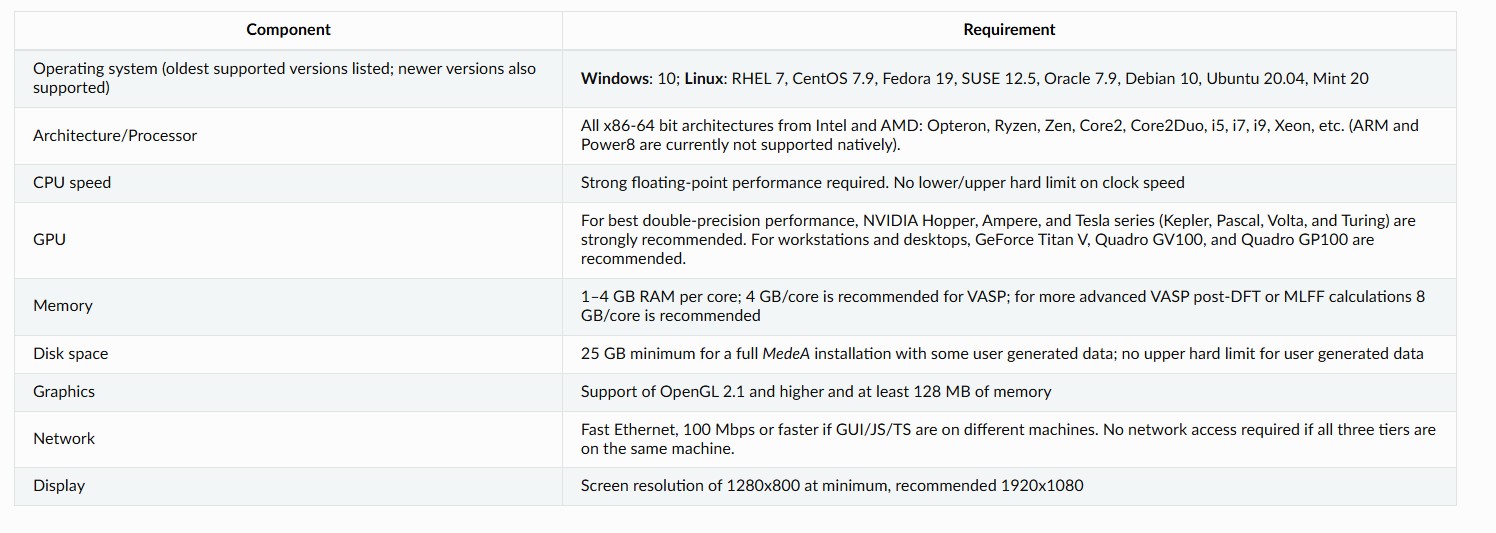
System Requirements for MedeA 3.10.0
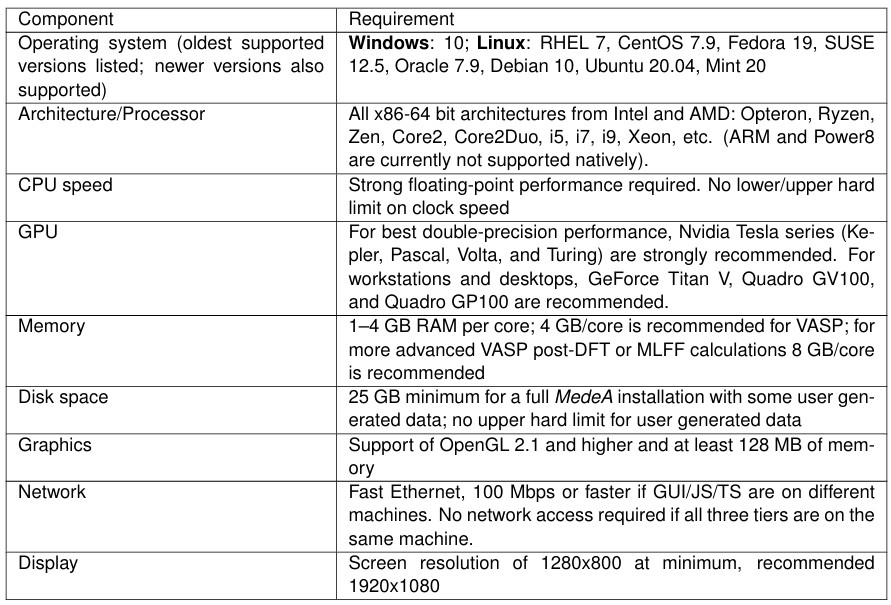
System Requirements for MedeA 3.9.0
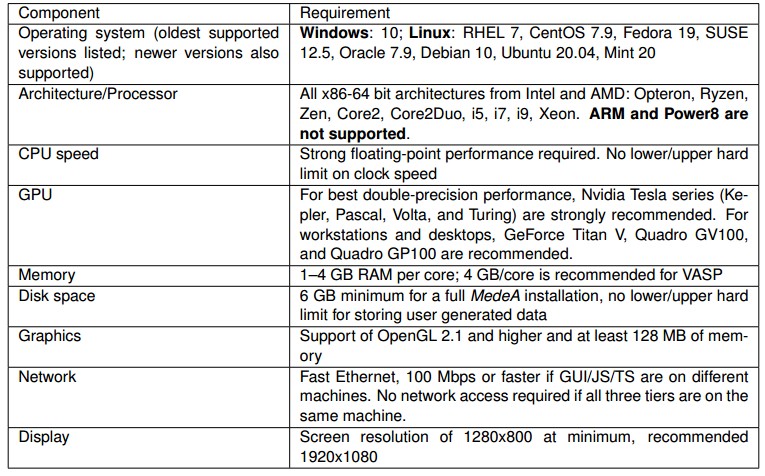
System Requirements for MedeA 3.8.0

MedeA Software details:
- Supported operating systems: Windows and Linux x64
- GPU: NVidia Tesla GPUs only
- Graphic: OpenGL 2.1 and higher
- Activation with license: single user for 1 PC
- License validity: Perpetual and lifetime
- File Size: 1.75 GB + 6.5 GB + 1.80 GB + 7.3 GB + 9.2 GB
- Note: In versions 3.10.0 and 3.9.0, there are 59 active modules in license. However, in version 3.8.0, 15 of them are not active. Similarly, in version 3.1.2, 18 of them are not active.
- Currently, in version 3.12.2, only these two modules, MLP Exploration and MLAP Property, are not active.



Comments