Download Piping Layout for Heat Exchangers 2025

Piping Layout for Heat Exchangers video course download, A heat exchanger is a system used to transfer heat between a source and a working fluid. Heat exchangers are used in both cooling and heating processes. The fluids may be separated by a solid wall to prevent mixing or they may be in direct contact.
A heat exchanger is a device that allows heat from a fluid (a liquid or a gas) to pass to a second fluid (another liquid or gas) without the two fluids having to mix together or come into direct contact. If that’s not completely clear, consider this. In theory, we could get the heat from the gas jets just by throwing cold water onto them, but then the flames would go out! The essential principle of a heat exchanger is that it transfers the heat without transferring the fluid that carries the heat.
You can see heat exchangers in all kinds of places, usually working to heat or cool buildings or helping engines and machines to work more efficiently. Refrigerators and air-conditioners, for example, use heat exchangers in the opposite way from central heating systems: they remove heat from a compartment or room where it’s not wanted and pump it away in a fluid to some other place where it can be dumped out of the way. The cooling fluid is completely sealed inside a network of pipes, so it never actually comes into contact with the air: it takes heat energy from the air inside and dumps it in the air outside, but it never mixes directly with that air.
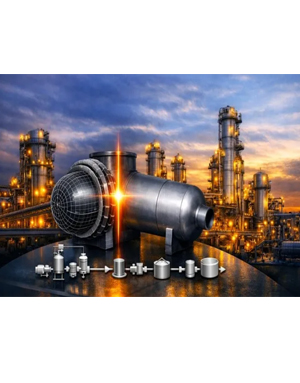
All heat exchangers do the same job—passing heat from one fluid to another—but they work in many different ways. The two most common kinds of heat exchanger are the shell-and-tube and plate/fin. In shell and tube heat exchangers, one fluid flows through a set of metal tubes while the second fluid passes through a sealed shell that surrounds them. That’s the design shown in our diagram up above. The two fluids can flow in the same direction (known as parallel flow), in opposite directions (counterblow or counter-current), or at right angles (cross flow).
What you’ll learn
- Classification of heat exchangers used in process plants
- Constructional and operating features of common exchanger types
- 3D Pictorial representations for better layout understanding
- Interesting facts: Optimizing Layout
- Tips and interesting facts to optimize heat exchanger layout for space, maintenance, and performance
Course content
- Classification of Heat Exchangers
- Direct contact and indirect contact types
- Recuperators, regenerators, and more
- Shell & Tube, Plate-type, Spiral, Finned Tube
- Constructional and Operating Features
- Components and internal structure of various exchangers
- Flow arrangements: counterflow, parallel flow, crossflow
- Maintenance and operating considerations
- Layout Aspects for Each Exchanger Type
- Shell & Tube Heat Exchanger
- Plate Type Heat Exchanger
- Spiral Heat Exchanger
- Key layout differences and constraints for each type
- 3D Pictorial Views
- Realistic visualizations of piping around exchangers
- Nozzle orientation, access clearance, and supporting
- Placement relative to other equipment
- Interesting Facts and Optimization Tips
- Space-saving layout tricks
- Accessibility and safety considerations
- Common layout mistakes and how to avoid them
Who this course is for:
- Piping and Layout Engineers
- Mechanical Engineers in the oil, gas, and chemical sectors
- Project and Design Engineers working on EPC projects
- Engineering students focused on process plant design
Course details
- Video quality: MP4 | Video: h264, 1280 × 720
- Audio quality: Audio: AAC, 44.1 KHz, 2 Ch
- Last updated 06/2025
- Video duration: 48m
- Number of lessons: 03 sections, 7 lectures
- Language: Language: English
- Compressed file size: 337 MB