Download Applied Mathematical Modeling in Chemical and Subsurface Energy Resources Engineering 2027
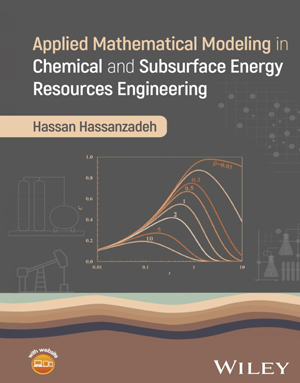
Analytical Methods for Modeling Chemical and Subsurface Energy Systems, Chemical engineering and subsurface energy applications involve complex physical processes that are often described by partial differential equations. Understanding these systems requires mathematical approaches capable of translating theoretical principles into practical engineering models.
The book explores a wide range of techniques for obtaining analytical solutions to partial differential equations, using detailed explanations and step-by-step examples. Different geometries and boundary conditions are considered to demonstrate how mathematical models can describe variations in temperature, concentration, and pressure across engineering systems. By connecting fundamental mathematical concepts with real-world applications, the book helps readers develop the skills needed to analyze complex chemical and subsurface energy processes.
Key Topics and Features
- Readers will find a broad selection of mathematical methods, engineering applications, and learning resources, including:
- An in-depth examination of analytical solutions to partial differential equations and their importance in understanding transport phenomena across chemical, environmental, and subsurface energy engineering.
- A detailed introduction to boundary value problems and essential mathematical approaches, such as separation of variables, eigenfunction expansions, Laplace and Fourier transforms, Duhamel’s theorem, Green’s functions, integral transform techniques, and similarity solutions.
- Practical engineering problems inspired by recent developments and research activities in chemical engineering and subsurface energy systems.
- Worked examples and visualization techniques that help explain mathematical results and strengthen the reader’s ability to interpret and develop engineering models.
- Extensive references and additional study resources that encourage further exploration of analytical modeling techniques and their applications in research and industry.
Applications and Intended Audience
This reference is intended for students, researchers, engineers, and technical professionals working in petroleum, chemical, environmental, and subsurface energy engineering. Its analytical approaches can be applied to a variety of physical processes, including diffusion, heat conduction, fluid advection, and chemical reactions.
The material is also relevant to professionals involved in developing computational and simulation software for subsurface energy applications. By presenting mathematical foundations alongside engineering-oriented examples, the book provides useful tools for understanding physical systems, validating numerical models, and developing more reliable simulation methods.
Combining mathematical rigor with practical engineering applications, this book serves as a valuable resource for anyone seeking to expand their knowledge of analytical modeling and the mathematical foundations of chemical and subsurface energy systems.
eBook details
- Author (s): Hassan Hassanzadeh
- Publication year: 2027
- Publisher: Wiley
- Language: English
- ISBN: 1394429045, 9781394429042, 9781394429059, B0HPQXTD69, 9781394429066, 9781394429073
- Pages: 561
- Book format: PDF
- File size: 10 MB