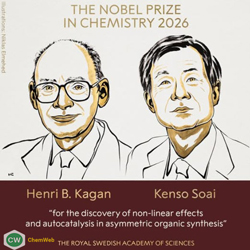
The 2026 Nobel Prize in Chemistry has been awarded to Henri B. Kagan of Université Paris-Sud, France, and Kenso Soai of Tokyo University of Science, Japan, for their discovery of nonlinear effects and autocatalysis in asymmetric organic synthesis.
Their groundbreaking research has advanced our understanding of molecular chirality—the phenomenon in which molecules exist as mirror-image forms. This discovery has helped explain how one molecular form can become dominant, offering important insights into the origins of life’s chemical asymmetry.
The laureates’ work has also had a significant impact on the development of pharmaceutical compounds, where controlling molecular chirality is essential for producing molecules with specific properties and biological effects.
Why the 2026 Nobel Prize in Chemistry Matters
The work recognized by the 2026 Nobel Prize in Chemistry has important implications for organic synthesis, pharmaceutical research, and our understanding of the chemical origins of life. Henri B. Kagan and Kenso Soai were honored for their discoveries concerning nonlinear effects and autocatalysis in asymmetric organic synthesis. Their research has helped scientists understand how chemical reactions can favor one mirror-image form of a molecule over the other.
Applications in Pharmaceutical and Industrial Chemistry
One of the most important applications of asymmetric synthesis is the production of chiral molecules for pharmaceutical use. Many organic compounds exist in two mirror-image forms, known as enantiomers, which can interact differently with biological systems. Being able to selectively produce the desired form is therefore essential in the development and manufacture of many medicines.
Beyond pharmaceuticals, advances in asymmetric synthesis can benefit the production of fine chemicals, agrochemicals, fragrances, and other specialized organic compounds. Improved control over chemical selectivity can help researchers develop more efficient synthetic routes, reduce unwanted by-products, and improve the consistency of chemical manufacturing.
Implications for Future Scientific Research
The discoveries of Kagan and Soai also raise fundamental questions about how molecular asymmetry first emerged in nature. Living systems rely on a strong preference for particular molecular forms, including specific amino acids in proteins. Understanding how chemical reactions can amplify a small initial imbalance between mirror-image molecules provides valuable insights into possible mechanisms behind this phenomenon.
Future research may build on these principles to design new catalytic systems, develop more selective synthetic methods, and investigate the relationship between chemical reactions and the origins of biological homochirality. Combining asymmetric synthesis with computational chemistry and advanced catalyst design could further expand the range of molecules that scientists can produce efficiently.
Overall, the 2026 Nobel Prize in Chemistry highlights how fundamental discoveries in reaction mechanisms can influence practical applications, from drug development to industrial synthesis, while also helping scientists explore some of the most significant questions about the molecular foundations of life.